Digital invoicing in Pakistan, explained
A plain-language introduction to digital and electronic invoicing in Pakistan: what it means, how it differs from paper invoices, and what it changes for a business.
What digital invoicing means
“Digital invoicing” and “electronic invoicing” (or e-invoicing) describe the same shift: instead of an invoice existing only in a business's own records, its details are sent electronically to a system that records and validates them. In Pakistan, that system is run by the Federal Board of Revenue as part of how sales tax is administered.
The word “digital” is doing more work than it looks. A PDF emailed to a customer is not a digital invoice in this sense. What makes an invoice a digital invoice here is that it is submitted, in a structured form, and gets a response confirming it was received.
Bizio Invoicing is an independent software provider. It is not affiliated with, endorsed by, or an official service of the Federal Board of Revenue (FBR) or PRAL. Whether, when and how digital invoicing applies to a particular business is set by FBR and has changed more than once. Check FBR's current notifications or ask your tax consultant.
How it differs from a paper invoice
The mechanics of an invoice — a seller, a buyer, some line items, a total — do not change. What changes is when the details have to be right and who else sees them.
- Timing. A paper invoice could be corrected quietly later. A digital invoice is checked at the moment it is filed, so it has to be complete and correctly coded then.
- Structure. Free-text fields give way to specific values — a province from a list, a unit that matches an HS code, a registration number that resolves to a real record.
- Proof. Instead of only your own copy, there is a recorded submission and a response, which is what you can point to later as evidence of what was filed.
The lifecycle of a digital invoice
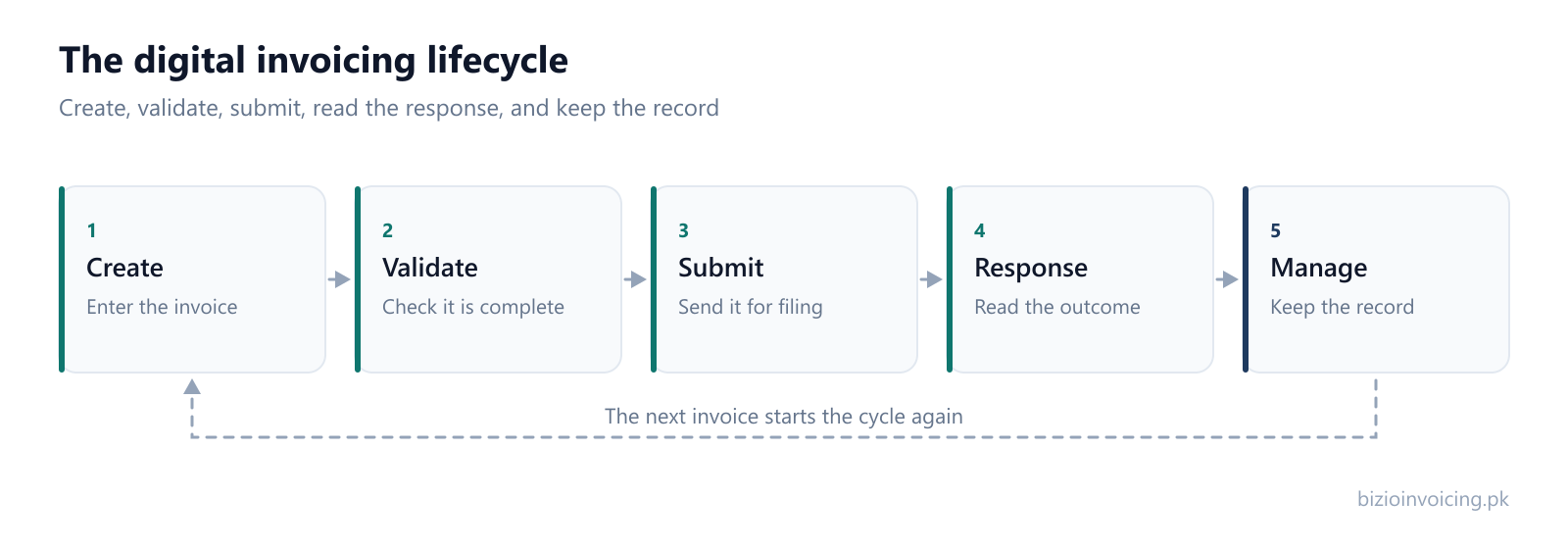
However the software is arranged, a digital invoice moves through the same stages: it is created, validated, submitted, answered, and then kept. The value of good software is mostly in making the validate step catch problems before the submit step, not after.
What it changes for a business
For most businesses the practical effect is that record-keeping has to be tidier than it used to be. Buyers need to be on file with the right registration details; products need a consistent classification; invoice numbers need to be unique. None of this is difficult, but it rewards doing once and reusing rather than improvising per invoice.
It also means the work moves earlier. The month-end scramble to reconcile invoices becomes a series of small, immediate checks at the point each invoice is issued — which is less work overall, once the records are in order.
Where Bizio Invoicing fits
Bizio Invoicing is an independent invoicing software platform for businesses in Pakistan. It helps you prepare digital invoices, check them, submit them to FBR's digital invoicing system using your own credentials, and keep the record — the lifecycle above, made routine.
It does not decide your tax treatment and it does not make a business compliant on its own; that still depends on the details you enter being right. If you are working out whether digital invoicing applies to you, the guide to FBR digital invoicing goes into the FBR side; the invoice requirements cover exactly what a compliant invoice carries.
Read next
FBR digital invoicing, explained
The FBR system specifically: what it is, whether it applies to you, and the terms you will meet.
Invoice software for Pakistan
What invoicing software has to handle for a Pakistani business, and how to tell if it actually does.
FBR invoice requirements
The blocks of information a compliant digital invoice has to carry.
Ready to file your first invoice?
Tell us your business name and registration number and we will set up your account. You start in sandbox mode, so nothing is filed for real until you are ready to switch to production.
WhatsApp +92 339 4453223 · bizio.official1@gmail.com